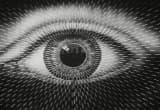
Produced in 1941 as part of the classic Knowledge Builders classroom series, Karl Kurt Bosse’s How the Eye Functions stands as an extraordinary artifact of early scientific filmmaking. While contemporary educational shorts often settled for crude chalkboards or rigid stop-motion slides, Bosse approached human vision with the precision of an optical draftsman and the visual flair of high-era modernist animation.
The film opens with an elegance rare for wartime instructional reels. A stylized study of a woman’s face, half-draped in shadow, yields to a glowing, superimposed diagram of the frontal lobes. From this initial nod to perception, Bosse dives directly into gross anatomy. Through delicate line drawings, the film peels back layers of the eye socket and orb, rendering the cornea, iris, and vitreous chamber not as dry textbook cross-sections, but as interconnected components of a living instrument.
Where the film truly shines is in its kinetic depiction of light. Bosse charts incoming light waves and photon trajectories as sharp, crystalline beams piercing the pupil. The refractive magic of the lens receives exhaustive, minute attention; extreme close-up animations isolate the lens suspended in its capsule, flexing and altering curvature to demonstrate accommodation in real time.
To anchor these abstract physics for a 1940s audience, Bosse leans on mechanical analogy, juxtaposing the focal mechanisms of the human eye against the adjustable aperture and lens barrel of a motion-picture camera. Binocular convergence is illustrated through a striking vignette: a solitary man seated at a table, geometric lines of sight projecting from his eyes to converge precisely upon the tip of a flickering candle flame.
Yet for all its didactic rigor, How the Eye Functions frequently brushes against the avant-garde. The climax features a haunting "wall of eyes" four horizontal registers of disembodied gaze drifting in alternating counter-currents across the screen. It is an arresting, faintly surreal sequence that bridges hard biological science and the dreamlike language of early mid-century experimental cinema.
Now resting in the public domain, Bosse's short remains a masterclass in educational graphic design, transforming complex optical physics into pure, luminous motion.