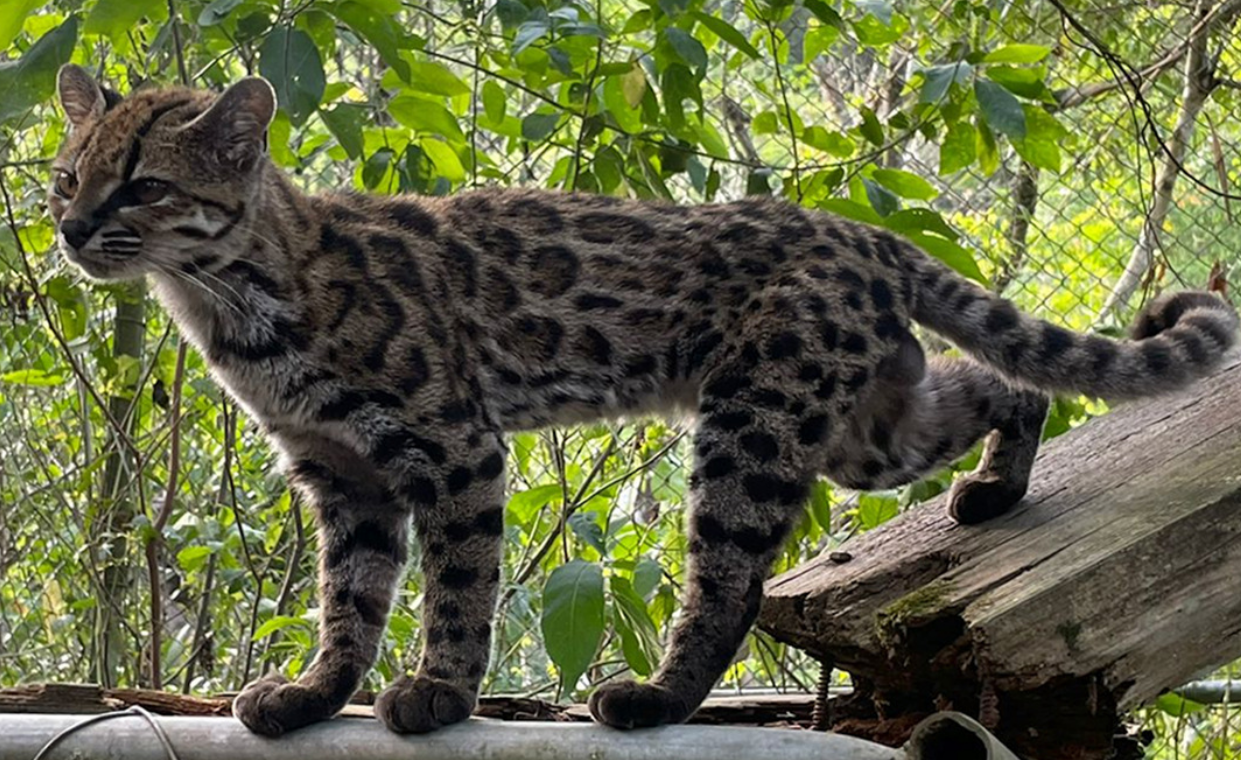
Scientists have confirmed that a small spotty cat species discovered in cloud forests of Bolivia is new to science.
This new cat species is called Leopardus tilcayo or the Tilcayo tiger cat.
It all started in 2016 when a man found a kitten along the forest road and brought it home, thinking it was a house cat. A year later it reached Senda Verde wildlife refuge in Bolivia.
Paola Nogales-Ascarrunz, a biologist who examined the cat, noticed that it was quite different from tiger cats already in science. She took its pictures and initiated her investigation. Eventually, geneticists studied the whole genomes of 38 cats belonging to Leopardus genus, including 8 museum specimens.
The genetic analysis confirmed that this Bolivian cat was separate. It was estimated that the Leopardus tilcayo species branched from other tiger cat species around 1.4 million years ago. Also, the research revealed that the genus that used to be called tiger cats actually consists of 5 different species.
The Tilcayo is very small, measuring approximately 42.5 to 50.5 centimetres and weighing about 1.4 kilograms. It has a light brown colour with irregular dark spots, short rounded ears, and long whiskers.
Scientists have only found one Tilcayo cat in human care so far, and they don't yet know how many are living in the wild or where their full habitat is.
Reference:
Lescroart et al. (2026), Current Biology, published September 17, 2026. “Phylogenomics and museomics reveal five distinct species of tiger cats in South America.”
DOI: 10.1016/j.cub.2026.08.059...
More About the Research
Why was this cat so difficult to identify?
One reason is that tiger cats are extremely similar in appearance. They are small, spotted wild cats belonging to the genus Leopardus, and differences between populations are not always obvious just by looking at their fur or body shape. Scientists have also known for years that the taxonomy of the tiger cat group was complicated, with genetic studies suggesting that some populations treated as one species were actually quite different.
The new study used a much more detailed approach. The researchers compared complete genomes from 38 Leopardus individuals, including eight specimens from museum collections. Those older specimens were particularly useful because museum collections can preserve genetic evidence from animals collected long before modern genomic studies were possible. The results showed that the tiger cat complex contains five distinct species, including the newly described Leopardus tilcayo. The study also identified a distinct subspecies in the Peruvian Yungas, Leopardus tigrinus antisuyo.
What does “1.4 million years ago” actually mean?
The estimated 1.4-million-year separation is an evolutionary estimate, not a date when someone first saw or named the animal. It means that the lineage leading to L. tilcayo has been genetically distinct from the other tiger-cat lineages for a very long period.
The researchers also looked at the cats' evolutionary history, including past gene flow between different cat lineages. This is important because evolution is not always a simple family tree in which species split once and never interact again. Closely related wild cats can sometimes hybridise, leaving traces of older genetic exchanges in modern genomes.
The biggest mystery is still the wild population
Although the species has now been formally described, scientists still know very little about L. tilcayo in the wild. At present, the individual at Senda Verde is the only known member of the species in human care. Researchers need field surveys, camera traps and genetic sampling to determine how widely the species occurs and whether other populations exist elsewhere in Bolivia.
Even basic questions remain open: How large is its range? How many animals are there? What does it normally eat? How does it reproduce? And does it occur outside the Yungas cloud forests?
Early observations provide some clues. Researchers have reported evidence suggesting that small rodents may be part of its diet, while camera-trap observations indicate possible nocturnal activity. These observations are still limited and should not be treated as a complete picture of the species' behaviour.
Why the discovery matters for conservation
Giving the cat its own species name is more than a taxonomic change. Conservation assessments depend partly on knowing exactly which animals belong to which species. If several genetically distinct lineages are grouped together, the size and distribution of the overall group can make an individual lineage appear more secure than it actually is.
The IUCN Cat Specialist Group has already noted that tiger-cat taxonomy is complicated and that further research into their ecology, natural history and threats is needed. The newly described L. tilcayo will require its own assessment once enough information is available.
The Yungas also faces pressure from deforestation, agricultural expansion, fires and mining. Researchers therefore need to find out not only where L. tilcayo lives, but also whether its remaining habitat is connected enough to support a viable population.
For now, the discovery is best viewed as the beginning of the research rather than the end. Scientists have established that this is a distinct species, but they still have to find out how common it is, where it lives and what it needs to survive.
References
Lescroart, J., Nogales-Ascarrunz, P., Cassatt-Johnstone, M., Bonilla-Sánchez, A., Charão Sartor, C., Angulo, F., Ramirez, J. L., de Oliveira, L. R., de Oliveira, T. G., Shapiro, B., Aliaga-Rossel, E., Svardal, H. & Eizirik, E. (2026). “Phylogenomics and museomics reveal five distinct species of tiger cats in South America.” Current Biology. PubMed record and study details
Sinding, M.-H. S. et al. (2023). “Extensive Phylogenomic Discordance and the Complex Evolutionary History of the Neotropical Cat Genus Leopardus.” Molecular Biology and Evolution. Full study on PubMed Central
IUCN SSC Cat Specialist Group. “Northern Tiger Cat (Leopardus tigrinus).” IUCN Red List information and species account. IUCN Cat Specialist Group species account
Universidad Mayor de San Andrés (UMSA). (2026). “Tilcayo, el pequeño felino de los Yungas que sorprende al mundo.” Institutional research and conservation background. UMSA article