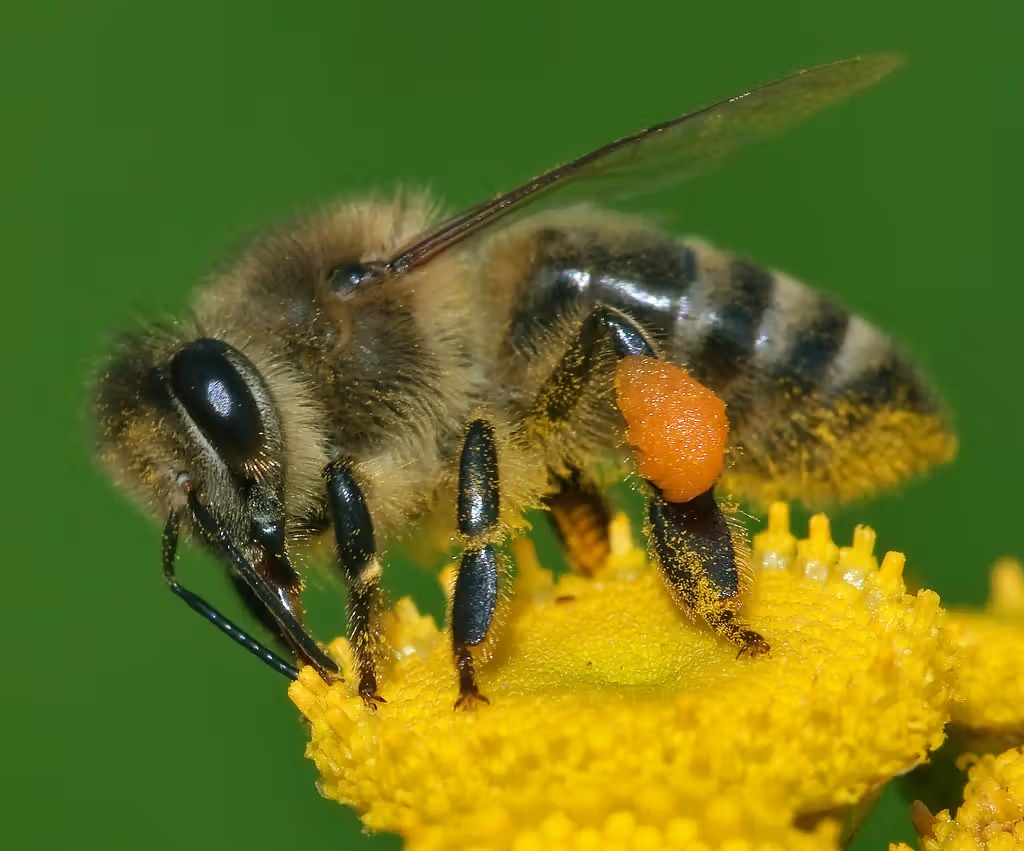
Honeybees provide so many benefits to humans that this is yet another reason to protect and preserve them. A very interesting fact I recently came across is that honeybee venom is being studied as an experimental agent in cancer research, particularly for its effects on human breast cancer cells.
So, does honeybee venom hold the potential to create new treatments for cancer? Scientists are focusing on a substance in honeybee venom called melittin (the main peptide component of the venom).
An interesting study published in 2020 in the journal npj Precision Oncology revealed that honeybee venom and its component melittin could destroy cancer cells very quickly under laboratory conditions. The researchers specifically studied melittin’s effects on triple-negative breast cancer (TNBC) and HER2-positive breast cancer cells.
They found that melittin has various mechanisms of action, including blocking cancer cell growth by acting on the HER2 and EGFR signalling pathways and causing the death of cancer cells by disrupting their membranes.
In some experimental settings, nearly 100% of the cancer cells were killed. Melittin also enhanced the effects of the chemotherapy drug docetaxel in the experimental studies.
Nonetheless, these results must be taken with caution: findings from laboratory studies do not necessarily mean the same results will occur in humans. Moreover, melittin can also affect healthy cells, so it is important to minimise potential adverse effects on non-cancerous tissues. Honeybee venom therefore remains an experimental area of research in the field of oncology.
Although the findings seem very encouraging and could possibly form the basis for new cancer therapies in the future, further research is still needed.
This is really a fascinating finding. Honeybees are full of surprises. Who knows what else we’ll discover?
Let’s help protect our honeybees.
Reference:
Duffy, C., Sorolla, A., Wang, E., et al. (2020). Honeybee venom and melittin suppress growth factor receptor activation in HER2-enriched and triple-negative breast cancer. npj Precision Oncology, 4, 24.
https://doi.org/10.1038/s41698-020-00129-0
More About the Research
So, what exactly is melittin?
One of the most interesting parts of this research is a substance called melittin. It is a major component of honeybee venom and has caught the attention of scientists because of the way it interacts with cells.
In the 2020 study by Duffy and colleagues, researchers looked at honeybee venom and melittin in relation to breast cancer cells, particularly triple-negative breast cancer (TNBC) and HER2-enriched breast cancer. They found that melittin could interfere with signalling involving receptors such as EGFR and HER2, while also damaging cancer-cell membranes.
That might sound simple, but there is a lot going on at the cellular level. Cancer cells rely on a number of signals to grow and survive, so researchers are interested in substances that might interfere with those processes.
How could bee venom affect cancer cells?
Melittin is particularly interesting because it can interact with cell membranes. In laboratory experiments, this interaction can damage the membrane and eventually contribute to the death of the cell.
The researchers also looked at whether melittin could be modified to make it better at targeting cancer cells while reducing its effects on healthy cells. One approach they investigated involved an RGD motif, which was explored as a way of improving the targeting of malignant cells.
This is an important area of research because simply being able to kill cancer cells in a laboratory isn't enough. A potential treatment would also need to avoid causing unacceptable damage to healthy tissue.
What about chemotherapy?
Another part of the 2020 research that caught my attention was the combination of melittin with docetaxel, a chemotherapy drug.
In the experimental work, melittin enhanced the effects of docetaxel. However, this does not mean that people receiving chemotherapy should use honeybee venom or melittin themselves. The research was preclinical, involving laboratory experiments and animal models rather than a clinical trial showing that the combination is safe and effective in people.
That distinction is really important whenever we read about exciting cancer research. A result in cancer cells in a laboratory can be an important first step, but there are still many stages between that discovery and a treatment that could be safely given to patients.
Is there newer research?
Yes. Interest in melittin hasn't stopped with the 2020 study.
A 2025 systematic review looked at 40 studies involving melittin and breast cancer. The researchers discussed several possible ways melittin could work, as well as different methods being investigated to deliver it more effectively. The review also highlighted the need for further clinical research before its potential as a breast cancer treatment can be established.
There is also a 2026 review looking more broadly at bee venom and cancer research, with particular attention to the possible anti-tumour effects of melittin. It discusses research involving different cancers, including laboratory and animal studies, as well as attempts to improve melittin's potential while reducing unwanted effects.
So this isn't simply a story about one interesting experiment from several years ago. Researchers are still investigating the subject.
But is honeybee venom actually a cancer treatment?
Not at this stage.
This is probably the most important point to take away from the research.
The findings involving melittin are interesting, but much of the evidence is still at the laboratory or animal-research stage. Researchers need to establish whether an approach is safe, how it should be delivered, what dose might be appropriate, and whether it actually works in people.
The National Cancer Institute explains that breast cancer treatment depends on factors such as the type and stage of the cancer and can involve treatments including surgery, radiation therapy, chemotherapy, hormone therapy, immunotherapy and targeted therapy. New approaches can also be investigated through clinical trials.
So, while honeybee venom and melittin are being studied, they should not be presented as an established cancer treatment.
Where could the research go from here?
This is where things get particularly interesting.
One of the biggest challenges is finding a way to make melittin affect cancer cells without causing unacceptable damage to healthy cells. Researchers are therefore looking at ways of improving its targeting and delivery.
The 2025 systematic review discusses several experimental delivery strategies designed to potentially improve melittin's usefulness while reducing toxicity.
Whether any of these approaches will eventually lead to a successful human treatment remains unknown. More research and properly designed clinical studies would be needed to find out.
For now, I think the fascinating part is simply that something produced by a honeybee is being investigated at such a detailed molecular level.
It is a good reminder that nature can provide scientists with some very unexpected starting points for research.
Honeybees already play an enormous role in our ecosystems and food production. And who knows: perhaps their venom will teach us something else about medicine too.
For now, though, the science is still developing, and melittin should be regarded as an experimental area of cancer research rather than a proven cancer treatment.
References
Duffy, C., Sorolla, A., Wang, E., et al. (2020). Honeybee venom and melittin suppress growth factor receptor activation in HER2-enriched and triple-negative breast cancer. npj Precision Oncology, 4, 24. https://pubmed.ncbi.nlm.nih.gov/32923684/
Prince, G., Assi, A., Aoude, M., Kourie, H. R., & Haddad, F. (2025). Melittin, A Potential Game-changer in the Fight Against Breast Cancer: A Systematic Review. Anticancer Agents in Medicinal Chemistry, 25(15), 1077–1084. https://pubmed.ncbi.nlm.nih.gov/40012288/
Boaventura de Oliveira, A. M., Amparo, T. R., Sant'Anna, M. B. M., Picolo, G., & Almeida, T. C. (2026). Bee Venom and Cancer: A Mini-review Focusing on Melittin Antitumoral Effects. Current Drug Targets. https://pubmed.ncbi.nlm.nih.gov/41879446/
National Cancer Institute. Breast Cancer Treatment. https://www.cancer.gov/types/breast/treatment